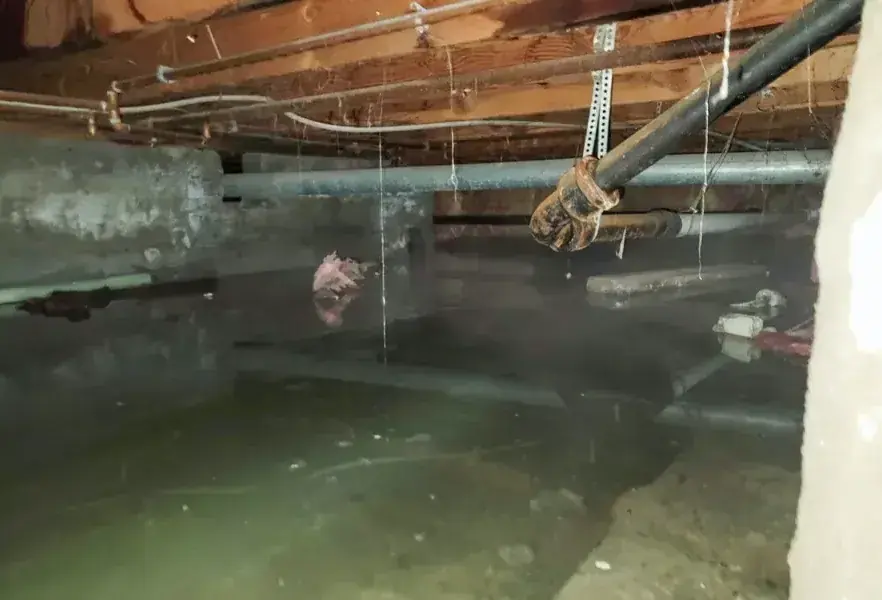
Around Arlington, most of the rain falls from October through March, and the first heavy fall storms are when many crawl spaces take on water. Wood frame homes on vented crawl spaces are the norm here, so what happens under the floor matters. This post shows how to tell standing water from damp air, what to do first and what the restoration team removes.
Key takeaways
- Most rain falls from October through March, so fall storms are the first test of a crawl space.
- Standing water, sagging insulation and a floating vapor barrier point to a real problem. A musty smell alone may only mean damp air.
- Supply pipes in crawl spaces can leak or split, so shut off the water before assuming rain is the cause.
- The team pumps the space, pulls wet insulation and vapor barrier, and dries the joists and subfloor.
- Never crawl into a space with standing water near wiring or ducts.
Standing water or damp air?
A crawl space can feel clammy for many reasons. What matters is whether water is sitting there.
Signs of standing water
These point to a cleanup job, not just a humid space.
- Water visible on the ground or in low spots
- Insulation that sags or has dropped to the ground
- A vapor barrier that floats or holds pools of water
- Wet joists with a dark tide mark
- A sump pump, if there is one, that runs without stopping
Signs of damp air only
These alone are usually a humidity problem.
- Condensation on pipes and ducts
- A cool, musty smell with no visible water
- Dry ground under the vapor barrier
When in doubt
Treat visible water as the real thing. Damp air can wait for a humidity fix, but standing water cannot.
Why fall rain finds the crawl space
The maritime Puget Sound climate sends most of its rain between October and March. Atmospheric river storms can drop a lot in a short stretch, and they melt Cascade snow on the way.
A vented crawl space is open to outside conditions by design. Homes in plateau subdivisions such as Smokey Point, Gleneagle and Crown Ridge, and homes in Old Town near Olympic Avenue, can all face the same question after a wet fall.
Heavy rain after a dry summer can also be the first time a gap or a clogged downspout gets tested. A crawl space that was fine last spring can still take on water now.
Water from outside
- Downspouts that empty beside the foundation
- Gutters that overflow in heavy rain
- Ground that slopes toward the house
- Vents and openings at ground level
Water from a pipe
Supply pipes in crawl spaces and exterior walls are exposed to cold, and washer, dishwasher and ice maker hoses can leak into the space below. A steady flow with no rain points to a pipe, and a split in a cold snap is covered under frozen pipe cleanup.
What to do first
Safety comes first. Water, wiring and a cramped space are a poor mix.
- Look from the access hatch with a flashlight and do not crawl into standing water
- Shut off the main water if a pipe may be the source
- Turn power off to the crawl space at the panel only if the panel is dry and easy to reach
- Photograph the water, the insulation and any damage from the hatch
- Do not run a household vacuum on standing water
What the restoration team pumps, pulls and dries
Pump
Water extraction uses pumps and hoses to clear standing water from the space. Getting the water out first keeps it from climbing into joists and the subfloor.
Pumping also lets the team see the ground and the joists clearly, which shows where the water came in.
Pull
Wet insulation holds water against the wood, so it comes out. A torn or soaked vapor barrier is pulled as well, along with debris that floated in.
Dry
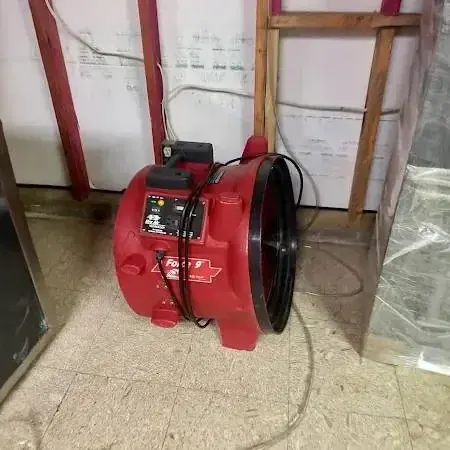
Crawl space water cleanup finishes with drying. Air movers and dehumidifiers are set for the space, and moisture readings on joists and subfloor show when the wood is done.
The wider job of drying the house above is covered under structural drying.
Dry joists and subfloor are the goal, not just a dry floor surface, because wood holds water inside.
Signs the water reached the house above
Rooms and floors
Water under the floor can move up into the subfloor and the bottoms of the walls. The rooms above should be checked with a moisture meter even when the floor looks fine.
- Cupped or buckled hardwood or laminate
- Soft spots in the floor
- Doors that start to stick
- Baseboards that darken or pull away
- A musty smell that returns after cleaning
Ducts, pipes and wiring under the floor
Insulation on ducts soaks up water and sags. Supply pipes and cables sit in the same space, so a wet crawl space can affect more than the floor.
- Duct insulation that hangs or is dark with water
- Pipe insulation that is soaked or dropped
- Corrosion or water marks at pipe fittings
- Any wiring that is wet or hanging low, which should be left to an electrician
Common mistakes with a wet crawl space
A few shortcuts make a wet crawl space worse. They are easy to avoid once they are known.
- Pumping out some water and leaving wet insulation in place
- Laying new insulation or a new vapor barrier over wet wood
- Ignoring a steady flow after the rain has stopped
- Blocking vents to stop the damp without finding the source
- Going in with household electrical tools while water is present
Keeping fall rain out next time
Maintenance cannot stop every wet season, but it keeps the water moving away from the house. Most of it can be done before October.
If the crawl space floods every year, a plumber, a drainage contractor or a grading specialist can look at the cause. Drying alone does not stop the next flood.
- Clear gutters and downspouts before the first big storm
- Send downspout water away from the foundation
- Check that crawl space vents are open and not blocked by dirt or plants
- Look into the crawl space after the first heavy rain each fall
- Know where the main water shutoff is
Questions
How can I tell if my crawl space has standing water?
Look from the access hatch for water on the ground, sagging insulation, a floating vapor barrier or wet joists. A damp smell alone may only mean humid air.
Is it safe to go into a flooded crawl space?
Not when water sits near wiring, ducts or a pump. Look from the hatch, take photos and let a trained team do the work.
What gets removed from a wet crawl space?
Wet insulation and a soaked or torn vapor barrier are removed. Joists and subfloor stay and are dried.
Can a pipe cause water in the crawl space?
Yes. Supply pipes and appliance hoses can leak into the space below, and a steady flow with no rain points to a pipe.
How do I know the rooms above are dry?
A moisture meter reading on the subfloor and the bottoms of the walls shows it. Cupped flooring and soft spots are signs it is not.
What should I tell the restoration team about a wet crawl space?
Describe what the hatch shows, where water enters, whether a pipe may be involved and whether the water has been shut off. Photos help.